
future of personal computing pt 1
July 10, 2026
the year is 2035.
you are walking in an anthropology museum with your family and you come across at a display on exhibit:
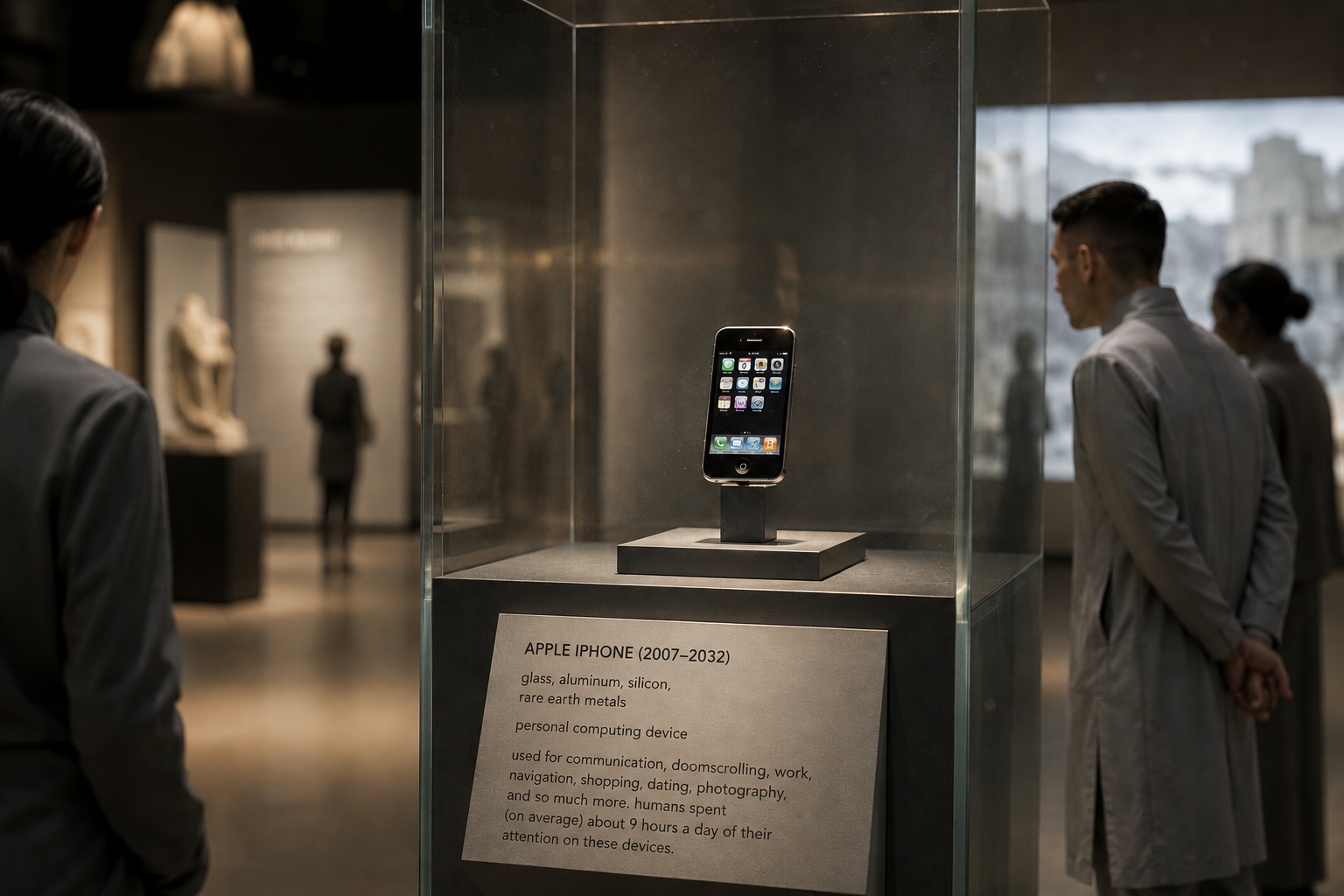
"ahhh yes, the iphone." you tell your kids. "that came before {BLANK}"
what was blank? how did our personal computing experiences change in the years leading up to this moment?
i'll be working backwards from what our ideal experiences should look like, what those experiences are, and the downstream impact on culture.
in this first post, i'll focus on problems with our current computing experiences, and ideal experiences. in later posts i'll dive deeper into specific mechanics, and the cultural impact.
throughout all personal computing tasks, there are two main problems we encounter:
- personalization - our devices lack sufficient knowledge to provide optimal experiences.
- specialization - computing is trapped in a single medium. because our current computing devices have been designed for a variety of tasks, they don't meet us where we are.
these two problems will require different solutions.
personalization
today, figuring out where to eat for lunch goes something like this:
- you pull out your phone
- you ask siri for food nearby
- you scroll the list and identify a place you'd like
- then you order (likely by placing an order online, manually entering in payment info, etc)
this process is broken. you eat everyday at 12:30. your tech should know you didn't bring a lunch, find a great place you should order from (based on past meals), suggest a good meal, and just pop up a quick confirmation where you can confirm the order.
it should be that simple.
but to get to this personalized experience, our devices need so much more context.
our phone might know food we ate if we ordered it online, but won't know any data otherwise (unless you are obsessively logging calories):
- how hungry you are
- if you plan on getting lunch with others
- meals you cooked at home
- if you attended an event with free pizza
- etc.
so what fills in this missing gap? what are some of the ways we can provide near perfect context to ai's?
the answer is a personal device we wear with a camera and mic.
personal context devices
in a future where we get develop cheaper, smaller, and more efficient chips, a smaller device will be possible. it'll be worn daily, and capture all the context needed for a personalized experience.
i envision a near invisible device with a camera + mic. it will likely take many forms - a necklace, an earbud, glasses. the main point is it will need to be something ambient that you forget is even there.
since it can see and hear everything you can, it will have near perfect data to build up context about your habits, preferences, and personality to best provide assistant-like care to you.
imagine you are cooking a stir fry meal at home while listening to a podcast. the device stores this in its current context:
- aaron is cooking a stir fry with broccoli, onions, carrots, soy sauce, chicken, and chives.
- aaron is listening to a podcast with tyler cowen and jackson dahl
and later even update the memory for "aaron cooked an asian stir meal"
later that day, you put food in storage container in the freezer.
then a week later when you eat it for dinner, AI can store this in its weekly data:
## weekly diet

monday 6/29:
- 3 scrambled eggs, onion, tomatoe, arugula
- chicken sandwich with avocado, peppers, habanero cheese
- salmon with potatoes and baby brocolli (sp on broccoli? I can't remember how to spell it either)

tuesday 6/30:
- 3 scrambled eggs, onion, arugula, and cheese
- red lentil soup with onion, carrot, tomato paste, arugula and lemon juice
- **asian stir fry with broccoli, onions, carrots, soy suace, chicken, and chives**

wednesday 7/1:
- 3 scrambled eggs, onions, and arugula
-
now, the clock hits 12:30p, your assistant can check your weekly meals, and will know that you didn't bring a lunch, and that you worked out this morning, and had a lighter breakfast. to balance things out, it suggests you eat a carne asada burrito from the spot nearby, just with a yes/no confirmation message.
this is only possible with the perfect context that a device like this can create, otherwise there are too many guesses.
we can extend this across many different tasks:
- getting from point a to point b
- making plans with friends
- cooking dinner (better example)
- etc.
today, users have to explicitly provide intent. tomorrow, AI will confidently act on intent it already has it.
generally, the personalization problem is most prevalent in tasks that require lower cognitive effort. ai will order me dinner, but won't write a blogpost for me.
specialization
today, devices like the smartphone and PC are portals to computing experiences. you can do so much:
- watch youtube shorts
- learn linear algebra
- build software for your grandma
- coordinate a party
i love my computer, and it does a lot of things well, but it doesn't meet me where i am.
why is it that we feel more in the flow state when writing with a pen than on a keyboard? why does sketching on an ipad feel more creative than doing mock-ups on figma?
in many ways, the devices we use today constrain us:
- they have limited ability to meet us in the real world and interpret context
- we are forced to meet them in a world filled with distractions — texts, tweets, and so much other noise.
in the future tech will meet us where we are most productive, in the real world!
2 changes will be most relevant:
- augmented reality
- intelligence in more devices
imagine a painter. they have a paintbrush they use daily for their work, but its more than that. it's been tuned to millions of the painters strokes, and helps them do generative exploration at any time.
the painter just speaks possible paths it'd like to see, and the ai can just determine their intent and generate four different paths that they can take. this all happen through the physical world through augmented reality(AR).
they can toggle selection, color tuning, with different side button son the brush to further improve their options.
all of this can happen away from the computer, and directly in touch with the medium itself:

now extend this out to writing, building, or any creative work. this is the future we will live in — a world with more opinionated and personalized experiences, enabling people to live their best lives, and do their best work.
so, how will we get there?
AR based experiences
companies like meta, snap, and raven are already working in this space. as the tech improves, it will become the best place to do creative work.
you can finally bring ai into the same 3D environment as you! pointing, dragging, and interacting in ways you could never have before on a computer.
new devices to wield intelligence
instead of computers, i imagine a new class of devices that we embed/augment with intelligence. everyday objects like pens, headphones, notebooks, and more!
through these devices, intelligence will meet us where we are, in the medium.
its possible the device itself has intelligence, or perhaps it actually is just designed to feel as if we are interacting with it, but in reality a combination of your personal device and AR makes it seem that way.
- maybe we just have haptics in our fingers, and ar/other devices generate a feeling that we interact with paint brush when its normal?
conclusion
while a device constantly monitoring your every move may sound scary, im quite excited for a future where i no longer need to think about frivolous things like what to eat for lunch, or how to get to my friends house.
this will free up so much of our time for the things that matter in the post-agi world — connections, experiences, and creative work.
for creative work, with advances like AR and cheaper chips, it will be easier than ever for people to do high quality creative work.
the idea that by 2035 we will see 10x more people doing creative work than we do today is so beautiful. what a time to be alive!
endnotes
privacy
in my opinion, this will largely go away.
in the 90s, putting your payment info on the internet felt weird. while a constantly on device is on another level, its inevitable that we will constantly be recorded for superior experiences with our tech.
perhaps ill dive into risks + potential futures in this regard in another blogpost!
mind reading tech
many people now use voice to communicate their intent to ai, but this is likely just a transition state until we (eventually) reach something even better - reading minds!
- meta is already making progress in this space. in the future, the notion of a keyboard or voice input will seem so odd....words are lossy!
as invasive as it may seem, this is clearly where the future is heading. i plan to dig deeper into how hci will change once this hits in a future post.