
getting a tree to sense touch
July 14, 2026
(but not actually)
beginnings
i've been dreaming of a world where intelligence is no longer limited to our personal devices, and instead is everywhere. i shoudl be able to go to a cafe, sit at a table, and learn about who sat there before me.
i've been calling this "communal computing" and hope to write more on the topic.
but for now, i decided to do a simple experiment - how could i get a tree to tell when it has been touched by a human, and respond?
so, like all people in 2026, i asked claude.
turns out, with a simple ESP32 and a piece of copper tape, we could do it!
so i asked claude how we could do that, and began the experiment.
process
everything around us can hold some amount of charge - flowers, chairs, even your pencil!
to understand how much charge a given object can hold, we can measure capacitance. if a human touches an object like a tree, they "join forces" and become one electrode, increasing the capacitance being measured.
so, to tell when a tree has been touched, all we need to do is measure the change in its capacitance.
to do this, we hook an ESP32 up to some copper tape on a tree. the ESP32 removes electrons from the electrode(tree) until it hits a voltage of 2.4V. then, it adds them back until it matched ground.
the time it takes to go through this process(measured in computer ticks) is the trees capacitance.
when a person touches the tree, the capacitance increases.
but, we ran into a problem. initially, the change in capacitance was only ~500 ticks. this was difficult to detect, since the wind and other environmental effects naturally change the trees capacitance by ~500.
after debugging with claude, it turns out this was because we were not hooked up to a ground wire.
the ESP32 measures voltage of an electrode relative to its own boards 'ground' of 0V. so 2.4V is just the delta.
but the problem is that the board ground is also the destination of the pulled electrons from the electrode. this means that as we pull electrons from the electrode and put it onto the board, the ground charge decreases.
the time it takes to "fill up" is very quick since the boards ground charge is decreasing as we are simultaneously increasing the charge in the electrode.
because of this, we were only getting about a +500 difference in capacitance(ticks to fill up to 2.4v) when touching the tree.
so i had to connect the boards ground GPIO pin to a stake in the ground.
this meant the board could send the electrons it pulled from the electrode down into the ground, while the 0v reference remained the same. see gpt slop image:
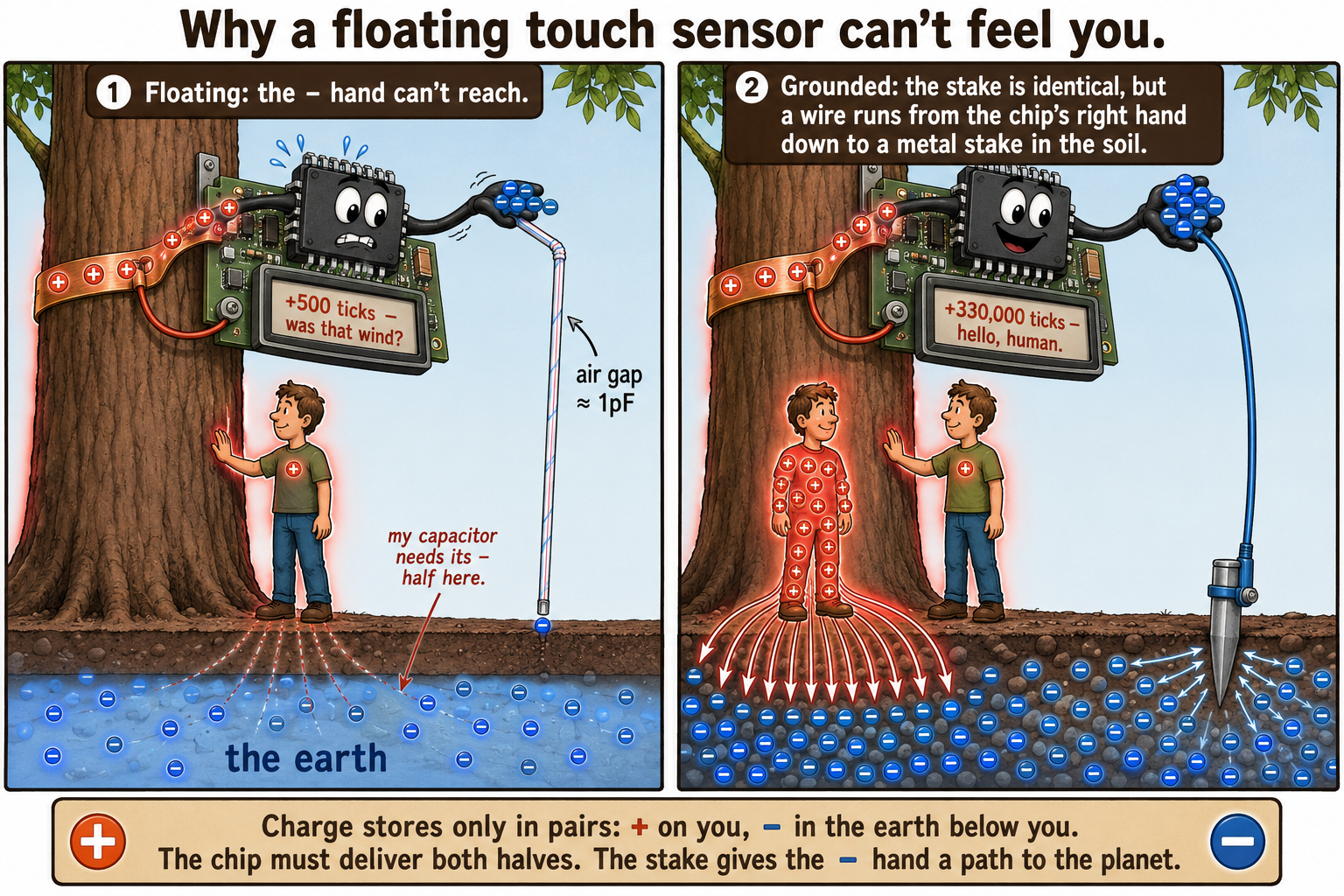
once we did this, we were getting about a +330k touch delta! very obviously easy to sense when someone touched it then.
learnings on relationship between voltage, capacitance and charge
charge is the actual difference between protons and electrons in a given electrode.
as each unit of charge is pulled from the electrode into the ground, the energy required to pull the next unit of charge out increases.
the voltage is the amount of energy required to move one unit of charge across the gap!
- measured per electron!
capacitance is the amount of time, measured in ticks, that it takes to increase the voltage up to 2.4v(in our case) and back down to 0v(ground).